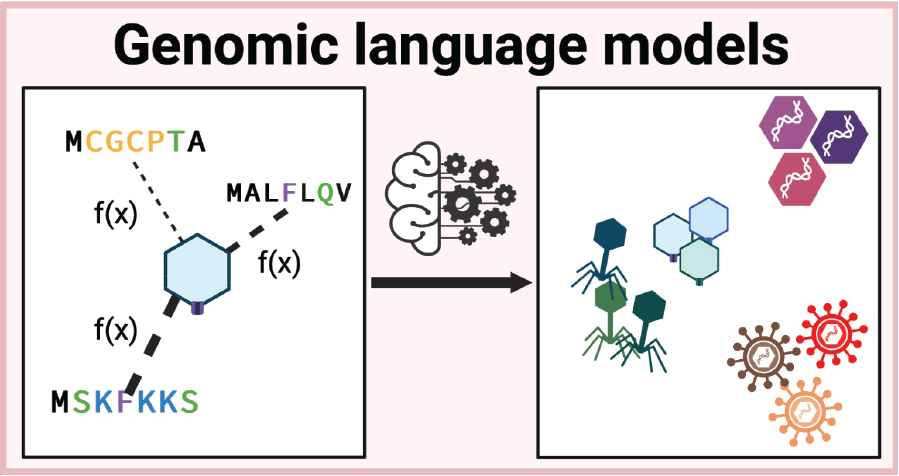


We develop computational and artificial intelligence approaches to identify novel genes, proteins, pathways, and ecological functions in microbial and viral genomes and metagenomes.
Broad areas of interest include:
- Genome and metagenome mining
- Protein and gene-function prediction
- Machine learning and foundation-model approaches
- Microbial and viral dark matter
- New computational methods and databases
- Predictive models of microbial and viral ecology and evolution
FEATURED DISCOVERIES AND PUBLICATIONS
Protein Set Transformer (PST) is a protein-based genome language model that treats viral genomes as sets of proteins, using an encoder-decoder transformer architecture to produce both genome-contextualized protein embeddings and genome-level embeddings in a single end-to-end model, making it the first foundation model purpose-built for viral genomics. PST outperforms existing homology- and language model-based approaches in capturing viral genome-genome relationships based on shared protein content, without relying on any external functional labels, and demonstrates a remarkable awareness of genome context. Because its embeddings are label-free and broadly applicable, PST is positioned as a foundational tool for a wide range of viromics tasks including taxonomy, host prediction, genome binning, and viral gene identification, with the potential to extend as a general foundation model for microbial genomics as a whole.
Check out PST on GitHub
Read our manuscript at Nature Communications
CheckAMG: Upcoming software to identify and characterize auxiliary viral genes

VIBRANT (Virus Identification By iteRative ANoTation) is an automated software tool for the recovery and annotation of bacterial/archaeal viruses, determination of genome quality and completeness, and metabolic gene identification. Highlighting viral auxiliary metabolic genes (AMGs) and metabolic pathways further allows the software to serve as a platform for evaluating viral community function. VIBRANT’s method utilizes a hybrid neural network machine learning and protein similarity approach to maximize identification of lytic viral genomes and integrated proviruses, including highly diverse viruses. VIBRANT was designed for use with complex metagenomic samples but also functions to identify viruses from cultivated or simple systems.
Check out VIBRANT on GitHub
Read our manuscript at Microbiome

METABOLIC (METabolic And BiogeOchemistry anaLyses In miCrobes) is a scalable software to study microbial metabolic traits and biogeochemical functional profiles of a microbiome/community based on microbial genomes. METABOLIC can help integrate genome-informed metabolism into metabolic and biogeochemical models. METABOLIC annotates genomes and organizes metabolic characterization at the scale of individual genomes and the entire microbial community. Additional analyses can be conducted to study genome abundance, sequential metabolic transformations, metabolic energy flow patterns, and metabolic interactions and networks at community scales. User-friendly results are provided in the form of curated tables and diagrams.
Check out METABOLIC on GitHub
Read our manuscript at Microbiome

vRhyme is a machine-learning based binning algorithm and software designed for viromes. vRhyme is fast and precise for construction of viral metagenome-assembled genomes (vMAGs). vRhyme incorporates supervised machine learning based classification of sequence feature composition as well as read coverage effect size comparisons to optimize the binning of vMAGs, which have properties distinct from microbial MAGs. vRhyme was tested on multiple artificial metagenomes as well as several unique systems (e.g., megaphage, NCLDV, eukaryotic virus, crAssphage, and prophage genomes) to display that it is precise with high genome recovery.
Check out vRhyme on GitHub
Read our manuscript at Nucleic Acids Research
